Yellow plant & heavy machinery
If your fleet is yellow — TLBs, excavators, dozers, graders, dump trucks, articulated haulers — you need trackers built for the way that equipment actually lives: high vibration, wide voltage, long idle hours, occasional dust and water immersion. The Teltonika FTC line was designed for exactly this, with the J1939 CAN readout that makes plant data actually useful.
Why your light-fleet tracker is wrong for yellow plant
An excavator runs for 2,500 idle hours a year. A TLB does 1,800 km in 12 months but works 6 hours a day. Your standard fleet tracker scores 'utilisation' on distance — which makes plant look idle when it's the most expensive thing on site.
Yellow machinery talks differently. Engine hours matter more than odometer. Fuel burn per hour matters more than km/litre. Hydraulic pressure, RPM under load, and idle-vs-working states are the operational truth. The FTC line reads all of that off the J1939 CAN bus.
Site theft is the other problem. Plant doesn't go on the road — it goes onto a flatbed at 2am. A standard SA fleet tracker geofence built around a depot misses the truck-and-trailer extraction. Plant trackers need different alert logic: 'moved without ignition' and 'powered off-site' beats 'crossed depot perimeter'.
Capabilities to look for
J1939 CAN bus on heavy plant
Read engine hours, fuel level, fuel rate, RPM, coolant temp, DPF/SCR status, hydraulic warnings off CAN — no extra sensors.
Wide voltage + surge protection
10-30V DC handles 12V skid steers and 24V dozers. Protected against the alternator spikes you get on big diesels.
IP-rated housings
Some FTC models in IP67 — dust and short-immersion water tolerance for site environments.
Movement-without-ignition alerts
Critical for plant theft — accelerometer-triggered alerts even when the machine is powered off, geofence-independent.
Hour-meter reporting
Maintenance scheduling against engine hours, not km — the only metric that matters for plant.
Devices for yellow plant & heavy machinery
Each device links to its full spec page. Add to your list and we'll come back with pricing.
The default for TLBs, mid-size excavators, graders. J1939 readout, wide voltage, robust install. Best price-performance.
Step up when you need extra I/O — hydraulic pressure sensors, multiple driver-IDs, fuel theft sensors via RS485.
Premium flagship for large yellow plant (dozers, ADTs) where you want the broadest CAN protocol support and most I/O.
How the data flows
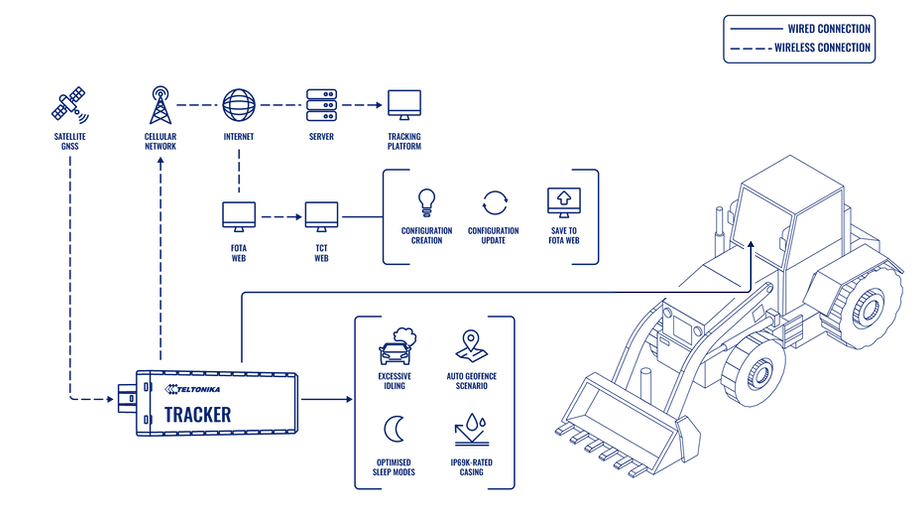
Engine hours and fuel data off CAN, optional LLS fuel probe on RS485 — feeds plant utilisation and theft-alert workflows.
Real-world scenarios
Typical setup — TLB contractor across multiple sites
Sites scattered across a province. Operators move TLBs between sites informally and fuel theft is the usual concern. FTC305 on each unit + an LLS fuel probe via RS485 gives a single fleet view of where each TLB is, current fuel level, and hours worked. The standard pattern for surfacing diesel pilferage and informal off-hire.
Typical setup — open-pit mine ADT fleet
Articulated dump trucks running 24/7. The OEM telemetry portal is expensive and proprietary. Switch to FTC965 with full J1939 readout — same data fed into the mine's existing Wialon stack. Predictive-maintenance flags from DPF + DTC events typically reduce unplanned breakdowns by a meaningful margin.
What you get out of it
- Engine-hours-based maintenance scheduling
- Site theft recovery via 'moved without ignition' alerts
- Fuel burn per machine, defensible for project costing
- Utilisation reports that reflect actual working hours, not km
- Cross-OEM telemetry — same data fed from CAT, Bell, JCB, Volvo, Komatsu
FAQ
Yes — for older plant without CAN, the FTC305 still reports GPS, ignition, ad-hoc fuel-level sensors via I/O. You lose the engine telemetry but keep theft recovery + utilisation. For very small skid steers we can go FMC125 hardwired.
Ready to spec it out?
We'll come back with pricing and a device recommendation tailored to your operation. Fast first reply during business hours, 08:00–17:00 SAST.