Marine & vessels
Marine environments destroy normal trackers. Salt spray, voltage spikes from generators, sealed housings, and IP67 dust/water tolerance aren't optional — they're the baseline. Teltonika's FTM line (FTM134, FTM305) is purpose-built for this; we resell it locally with the same protocols, in ZAR, with no waiting for a Lithuania shipping label.
Why your fleet tracker won't survive a vessel
Marine deployment is unforgiving. A fleet tracker mounted on a fishing vessel will see saltwater spray, alternator-spike events from the genset, and prolonged 100% humidity. Standard automotive trackers fail in 6-12 months in these conditions.
The Teltonika FTM line is designed for this from the ground up — sealed IP67 housings, wide voltage range (typically 9-30V DC to handle 12V and 24V marine systems), surge protection, and certifications for marine use. Same Teltonika protocols and platform support as their road units, just hardened.
Applications range from small harbour craft to commercial fishing fleets to luxury yacht insurance compliance. The hardware is similar across all of them; what changes is the install spec.
Capabilities to look for
IP67-rated sealed housing
Dust-tight, water-immersion-tolerant. Survives saltwater spray, washdowns, deck-level deployment.
Wide voltage tolerance (9-30V)
Handles 12V and 24V marine electrical systems, with surge protection against alternator spikes.
NMEA / J1939 marine bus support
Some FTM variants read marine engine telemetry directly off the marine CAN bus.
Battery backup
Built-in battery for continuity through ignition cycles and brief power-loss events.
Magnetic / through-bolt mount
Multiple install options for hulls, bridges, generator skids.
Devices for marine & vessels
Each device links to its full spec page. Add to your list and we'll come back with pricing.
Marine-grade sealed tracker, IP67, wide voltage. The default for small to medium vessels and gensets.
Marine FMS vessel tracker with NMEA support — for commercial fishing fleets and larger vessels needing engine telemetry.
Battery-only Cat-1 asset tracker for small craft, outboards, or non-powered marine assets.
How the data flows
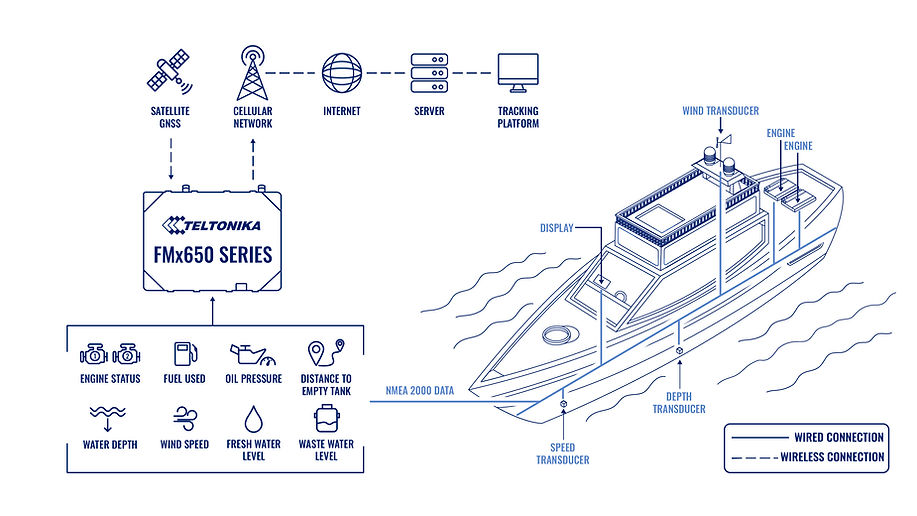
Marine-grade sealed unit, wide-voltage tolerance for 12V/24V systems, surge-protected against alternator spikes.
Real-world scenarios
Typical setup — small commercial fishing fleet
Owner-operator scale fishing fleet with insurance-driven trip logging and grounds-awareness requirements. FTM134 on each vessel paired with geofences over working grounds. Survives multiple seasons of salt-spray exposure where automotive trackers fail within months.
Typical setup — yacht charter / luxury craft
Premium yacht charter where insurance demands continuous position reporting + after-hours geofence around the home harbour. FTM305 with NMEA readout for engine hours and a Cat-M1 SIM with regional roaming. Provides the position evidence underwriters typically ask for on high-value craft.
What you get out of it
- Marine-grade durability — significantly longer deployment life than automotive units in salt-spray environments
- Position evidence for insurance compliance on vessel-mounted GPS
- Engine telemetry from NMEA / marine CAN where supported
- Single Teltonika platform across road + marine fleets
- Operational trip-logging that survives the marine environment
FAQ
Short-term, yes. Long-term, no — the housing fails in marine humidity and the voltage tolerance isn't designed for marine alternator behaviour. We always quote the FTM line for marine.
Ready to spec it out?
We'll come back with pricing and a device recommendation tailored to your operation. Fast first reply during business hours, 08:00–17:00 SAST.
Other use cases