Cross-border SADC operations
If your trucks cross into Mozambique, Zambia, Botswana, Zimbabwe, Namibia, or Lesotho, your tracker has to survive carrier handovers, signal blackspots at remote border posts, and roaming costs that can quietly destroy a fleet's margins. The Teltonika FMM line (Cat-M1 + NB-IoT) is the right tool for cross-border SADC — but only with the right SIM strategy. We help with both.
Why standard SA trackers go dark at the border
A South African SIM hits the border, switches to the foreign carrier, and one of three things happens. Best case: it roams and you pay through the nose. Common case: it sits in carrier purgatory for hours while it negotiates the handover. Worst case: the device gives up and waits for a 2G fallback that never comes.
Cat-M1 (LTE-M) is the modem profile that handles this better than anything else. Lower power, better deep-signal performance at remote border posts, designed by the cellular industry specifically for IoT roaming. Pair it with a multi-carrier SIM and you get a single number that works across SADC without per-country swaps.
The Teltonika FMM920 and FMM150 are both Cat-M1 with NB-IoT fallback — the FMM line is our default for any cross-border brief. (The FMC line is Cat-1 — fine for SA-only fleets, but Cat-M1 has the roaming edge once you cross a border.)
Capabilities to look for
Cat-M1 LTE with NB-IoT fallback
Cleanest roaming behaviour into Mozambique, Zambia, Botswana, Zimbabwe, Namibia. NB-IoT picks up in deep-signal blind spots.
Multi-carrier SIM compatibility
Works with cross-border SIM providers (e.g. Vox Telecom, Cellsmart, Comcellns). One SIM, multiple countries.
Geofencing across borders
Set entry / exit geofences at Beitbridge, Lebombo, Kazungula, Skilpadshek — alert on crossings, dwell-time at the post, unexpected detours.
Offline buffering
Devices buffer position records in flash memory and transmit when signal returns — no gaps in the trip log.
Devices for cross-border sadc operations
Each device links to its full spec page. Add to your list and we'll come back with pricing.
Cat-M1 + NB-IoT OBD plug-in. The default for cross-border bakkies, vans, and pool cars — Cat-M1's roaming and deep-signal advantage is the point.
Cat-M1 + NB-IoT advanced — for trucks that need driver-ID, fuel sensors, or a camera input on top of cross-border GPS.
Cat-1 FMS truck tracker for heavy combinations on JHB-Beira / JHB-Lusaka. Pair with a multi-carrier SADC SIM for roaming reliability on the truck itself.
How the data flows
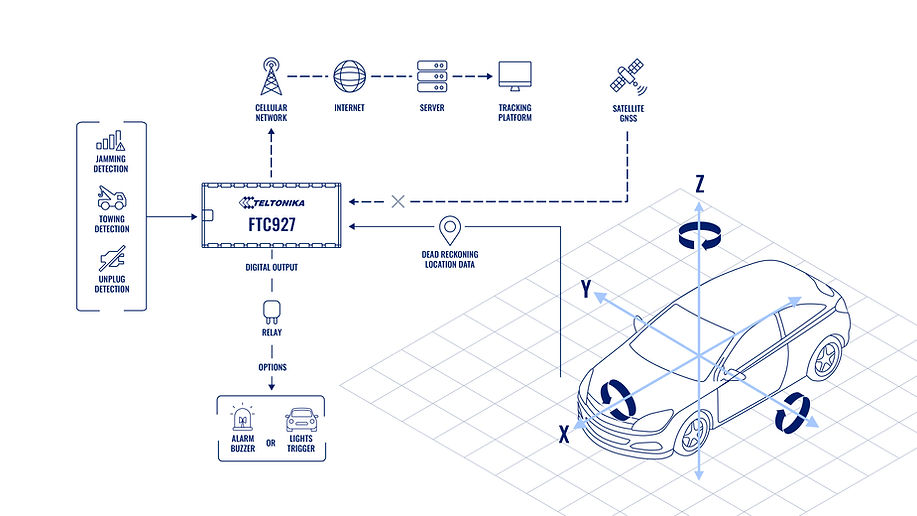
Cat-M1 + NB-IoT + multi-carrier SIM survives the SA → SADC carrier handover. Border-post geofences fire enter/exit events for billing and compliance.
Real-world scenarios
Typical setup — pharma distribution JHB → Maputo
Cold-chain pharmaceuticals via the N4. Border dwell at Lebombo can be 4–12 hours. The customer brief: an audit trail showing temperature stayed in range *and* the truck didn't divert. FMM150 (Cat-M1 + NB-IoT) with temperature probe via RS232 + multi-carrier SIM + Wialon geofence on the border crossing. Defensible chain-of-custody for GDP audits.
Typical setup — coal/freight haulage SA → Zambia
Trans Kalahari corridor, fleet doing weekly runs. The usual problem: SA-only SIM trackers drop offline at random points in Botswana. The remedy: FTC305 on the truck (Cat-1 FMS readout) paired with FMM920 on the pilot vehicle (Cat-M1 + NB-IoT for roaming continuity) and a multi-carrier SIM across the fleet — clean trip uptime across the corridor and fuel-burn audits that survive the client's queries.
What you get out of it
- Roaming costs predictable (multi-carrier SIM, no surprise bills)
- Border dwell-time tracking — billable per-hour to clients
- No gaps in the trip log across signal blackspots
- Real-time geofence alerts on border crossings, unauthorised detours
- Single hardware spec across the whole SADC fleet
FAQ
An MTN/Vodacom SIM will roam, but it'll cost you. For frequent cross-border ops we recommend a multi-carrier IoT SIM (Vox, Cellsmart, Comcellns) that has roaming agreements across SADC. We can quote SIMs as part of the package.
Ready to spec it out?
We'll come back with pricing and a device recommendation tailored to your operation. Fast first reply during business hours, 08:00–17:00 SAST.
Other use cases