Heavy freight & long-haul
Heavy trucks generate more data than any light vehicle — and a tracker that can't read the J1939 bus throws most of it away. The Teltonika FTC line was built specifically for diesel rigs, articulated combinations, and heavy plant. We resell the full range in SA, with the same protocols, no grey-market risk, ZAR pricing.
Where light-fleet trackers fall over on heavy
A truck broadcasts engine hours, fuel level, RPM, coolant temperature, AdBlue level, axle weights, EBS data, and DPF/SCR status over the J1939 bus. A standard OBD tracker built for sedans can't read any of it. You end up paying for telemetry you can't access.
The Teltonika FTC line (FTC305, FTC924, FTC965) connects directly to FMS-J1939 and exposes those parameters to your platform. That changes what you can do with fleet management — predictive maintenance, route-optimised fuel reports, driver scoring against fuel burn instead of just speed.
We help you pick the right FTC variant for your stack. A short-haul tipper doesn't need the same I/O headroom as a cross-border reefer combination.
Capabilities to look for
FMS-J1939 CAN bus readout
Engine hours, fuel level, fuel consumption rate, RPM, ambient temp, AdBlue, accelerator pedal position, DTCs — all from the CAN bus, no extra sensors needed.
Wide voltage tolerance (10-30V DC)
Handles the 24V electrical systems on most heavy trucks and the 12V on light-duty. Protected against alternator spikes.
Multi-I/O for sensor expansion
Add weighbridge sensors, fuel-level probes (LLS), driver-ID iButtons, panic buttons, refrigeration controllers — most FTCs have 4+ DIN and 2+ AIN inputs.
Cat-1 LTE with broad SA carrier reach
Full Cat-1 throughput on MTN, Vodacom, Cell C and Telkom. For cross-border SADC routes where roaming reliability is the priority, pair the truck with an FMM-series unit (Cat-M1 + NB-IoT) on the bakkie / pilot vehicle.
Devices for heavy freight & long-haul
Each device links to its full spec page. Add to your list and we'll come back with pricing.
Purpose-built FMS truck tracker. Reads J1939 CAN bus natively. Good middle-ground for most diesel rigs.
Step up when you need extended I/O — extra fuel sensors, weighbridge inputs, multiple driver IDs, panic buttons.
The flagship — premium FMS with advanced I/O, full sensor expansion, and the broadest CAN protocol support.
How the data flows
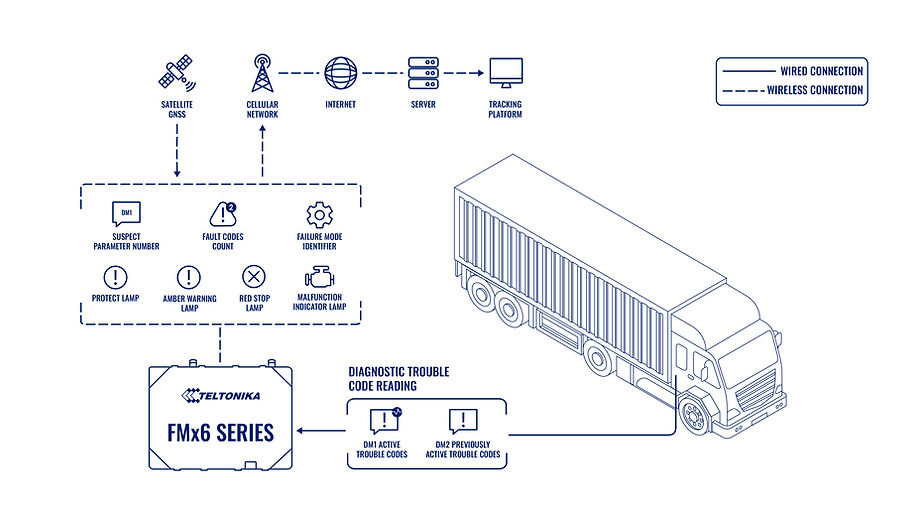
Engine data off the J1939 bus, encrypted over LTE Cat-1 to your platform — fuel burn, RPM, DTCs, hours all in one feed.
Real-world scenarios
Typical setup — cross-border reefer combination, JHB → Beira
Weekly cross-border runs into Mozambique. The fleet needs fuel burn per leg (for client billing), trailer EBS health, and temperature inside the reefer. FTC924 on the tractor + TAT240 on the trailer + a temp probe via RS232. Reports surface in the operator's existing Wialon platform.
Typical setup — short-haul tippers
Short-haul 8×4 tippers moving aggregate. Fuel theft is the dominant cost concern. FTC305 reading the CAN bus + LLS fuel probes via RS485 gives a real-time fuel-level chart that flags fills vs. drops — the standard pattern for catching diesel pilferage on quarry / construction tipper ops.
What you get out of it
- True FMS-grade telemetry — not just GPS + speed
- Predictive maintenance from DTC fault codes
- Fuel-burn reporting accurate enough for client billing
- Driver scoring against real engine data, not just GPS-derived metrics
- Single hardware family across tractor + trailer (FTC + TFT)
FAQ
If the truck has a J1939 CAN port (most post-2005 European/Asian heavies, post-2010 American), yes. Pre-J1939 diesels still get GPS, ignition, and ad-hoc sensors via I/O — just no CAN data. We'll spec on a case-by-case for older fleets.
Ready to spec it out?
We'll come back with pricing and a device recommendation tailored to your operation. Fast first reply during business hours, 08:00–17:00 SAST.
Other use cases