Fleet vehicles
If you run cars, vans, light commercials, or bakkies, this is your starting point. We resell the Teltonika devices most SA fleets actually use — OBD plug-in trackers for fast deployment, hardwired units for vehicles that need to integrate with sensors. Same hardware Teltonika ships globally; ZAR invoices and local setup support from us.
Why fleet tracking gets messy in SA
Most SA fleets juggle three or four problems at once. You want to know where every vehicle is in real time. You want to catch unauthorised after-hours use. You want fuel-burn reports that aren't a fight to produce. And ideally you want it without paying R350-a-month-per-vehicle in perpetuity to a tier-1 brand.
The hardware part is solved — Teltonika has units that fit every fleet shape. The harder bit is picking the right one for *your* operation. An OBD plug-in is great for a rental fleet you can't cut wires on; a hardwired CAN unit is the right call if you need engine RPM and DTC fault codes. The wrong choice means re-installing 20 vehicles. We help you avoid that.
Capabilities to look for
Real-time GPS with SA carrier coverage
MTN, Vodacom, Cell C, Telkom — all supported on Cat-1 and Cat-M1 LTE. NB-IoT fallback in low-signal areas.
OBD II or hardwired install
Plug-and-play OBD for fast rollouts, or hardwired with ignition wire for tamper resistance.
Driver behaviour data
Harsh braking, acceleration, cornering, idling — every Teltonika device reports it; how you score it depends on your platform.
Bluetooth onboard
Most Cat-1 FMC models include BLE for driver-ID iButtons, temperature sensors, and beacon-based proximity tracking.
Devices for fleet vehicles
Each device links to its full spec page. Add to your list and we'll come back with pricing.
The default. OBD plug-in, Cat-1 LTE, Bluetooth onboard. Same-week ship from our SA stock for FMC920 and FMC150.
Step up to advanced I/O and a camera input — for fleets that need driver-monitoring or extra sensors.
Hardwired with RS232/RS485 serial ports — when you need to talk to LLS fuel probes or industrial sensors.
Cat-M1 + NB-IoT equivalent of FMC920 — pick this when cross-border roaming or deep-signal coverage matters more than raw throughput.
How the data flows
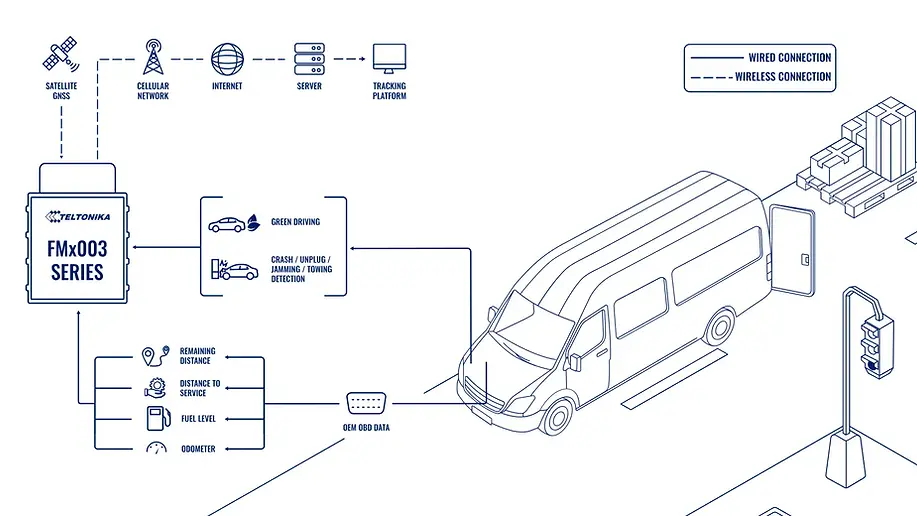
Vehicle → carrier handover → platform ingestion → live fleet view. Same flow for OBD plug-in or hardwired install.
Real-world scenarios
Typical setup — sales fleet, pool car model
Drivers rotate cars weekly. The company doesn't want to install wired trackers in vehicles that get sold every 36 months. FMC920 clips into the OBD port in under 60 seconds per vehicle — no auto-electrician, no warranty risk. When the lease ends, the tracker leaves with you.
Typical setup — mixed bakkies + LDVs
Bakkies on site need rugged install (no OBD that drivers can yank). LDVs in town can run OBD. Same Teltonika protocol on both — FMC920 OBD for the LDVs, FMC125 hardwired for the bakkies — single platform feed, single quoting process.
What you get out of it
- Lower total cost of ownership than equivalent monthly-subscription fleet services over 3 years
- No long lock-in contracts — devices are yours from day one
- Multi-platform compatible (Wialon, Traccar, Flespi, custom API)
- Local SA setup support — APN, server endpoint, I/O wiring
- Drop into your existing platform; no migration headache
FAQ
If it's post-2008 and OBD II compliant (almost everything sold in SA is), FMC920 plugs in and reports. For pre-2008 diesels and yellow plant we go hardwired with FMC125 or step up to FTC305 for trucks.
Ready to spec it out?
We'll come back with pricing and a device recommendation tailored to your operation. Fast first reply during business hours, 08:00–17:00 SAST.
Other use cases