Minibus taxi & public transport
The SA minibus taxi industry moves more people than any other transport mode in the country — and runs on a fleet model totally unlike corporate trucking. Owner-driver splits, association routes, daily takings reconciliation, rank dwell-time fights. Most off-the-shelf fleet trackers were built for corporate fleets and miss the operational realities. We spec Teltonika hardware around what the industry actually needs: simple driver-ID handover, route geofencing, owner-visible takings logic.
Why corporate fleet trackers don't fit the taxi industry
A minibus taxi isn't owned the way a corporate vehicle is owned. The vehicle owner often isn't the driver. The driver pays a daily target. The route is governed by an association permit. Dwell time at the rank is part of the operating model, not a flag.
Layer that on top of physical realities: high vibration, dust ingress on dirt roads, multiple drivers per shift, payment systems that may include a taxi-meter or a fare-collection app. A tracker that doesn't account for this either reports false 'idling' alerts every shift handover or fails to surface the owner-relevant data: takings vs. trips, route compliance vs. permit, rank queue position.
Teltonika's FMC line handles the physical durability. The trick is configuring the tracker for taxi reality — iButton driver-ID for shift handover, geofences around the rank and route, and integration with fare-collection where the operator wants it.
Capabilities to look for
Multi-driver iButton handover
Each driver carries an iButton key. Tap on shift start, tap on shift end — the tracker logs trips, takings windows, and driver-specific behaviour by ID.
Route geofencing per permit
Polygon geofences along the association permit route. Out-of-permit deviations flag for the owner / association.
Rank dwell-time logging
Distinguish rank queue time (legitimate) from off-route stops (suspect) using nested geofences and ignition state.
RS232 taxi-meter / fare-collection integration
Where the operator runs a digital fare system, RS232 brings takings into the same data feed as GPS.
Tamper-resistant hardwired install
Hidden install, fused, ignition-aware — drivers can't pop the OBD plug or pull power.
Devices for minibus taxi & public transport
Each device links to its full spec page. Add to your list and we'll come back with pricing.
Hardwired Cat-1 with RS232/RS485 for taxi-meter integration + iButton driver-ID. The default for taxi association rollouts.
Compact CAN-aware unit when the minibus is a modern fleet vehicle (e.g. Quantum Hi-Ace) with engine telemetry available.
OBD plug-in fallback for newer minibuses where the owner wants a fast, no-install deployment for a trial period.
How the data flows
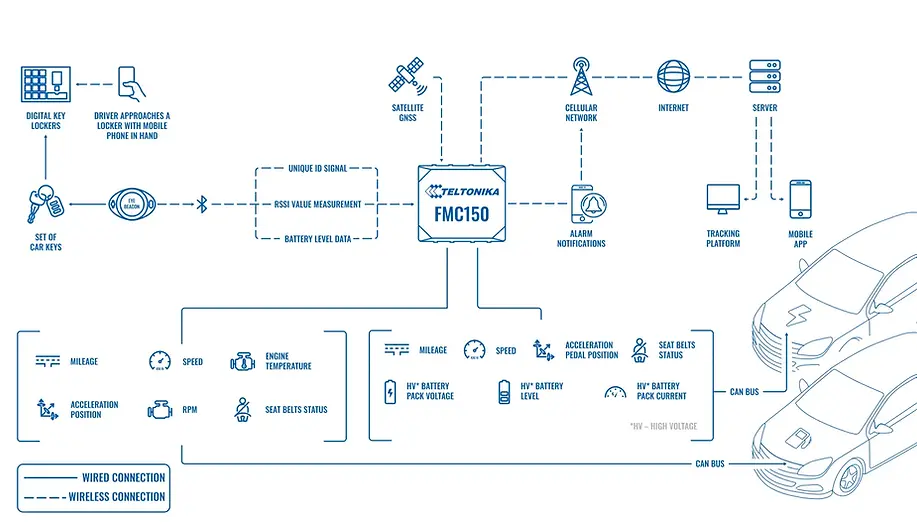
Driver iButton tags shift handovers; route geofences match permit. Fare-collection data via RS232 reconciles trips to takings.
Real-world scenarios
Typical setup — taxi-association compliance project
Association mandates tracking on its permit-holders to flag out-of-route taxis and improve safety-record submissions. FMC125 hardwired in each kombi + iButton per driver + Wialon with permit-route geofences. Reports flag deviations and dwell hot-spots for association management.
Typical setup — owner with 6 kombis, owner-driver visibility
Vehicle owner wants daily takings reconciliation against trips logged. FMC125 + RS232 to the fare-collection device + custom Wialon report — owner sees trips, takings, route compliance, and driver shift in one dashboard. Surfaces the difference between a slow day and a 'slow day'.
What you get out of it
- Owner-driver takings reconciliation that previously relied on trust alone
- Route compliance evidence for association / permit audits
- Driver-specific behaviour scoring across multi-driver shift patterns
- Reduced disputes over rank dwell vs. unauthorised off-route stops
- Single tracking platform across association fleets
FAQ
Hardwired install + ignition-aware power + tamper detection make it hard to disable casually. Repeated tamper events themselves become an alert + scoring signal. We spec the install to be hidden where possible.
Ready to spec it out?
We'll come back with pricing and a device recommendation tailored to your operation. Fast first reply during business hours, 08:00–17:00 SAST.