Asset & trailer tracking
Unpowered assets are the hardest to track because there's no battery to plug into. Teltonika's TAT (BLE + cellular variants) and TFT (hybrid power) lines solve this with multi-year onboard batteries and IP67 housings. Stick them on, set the report interval, forget them for 3-5 years.
Why asset tracking gets ignored until something disappears
Most fleet operators have one big tracker on the truck and nothing on the trailer. Then a trailer goes missing at a depot, an interchange driver picks the wrong one, or a container is stolen between the port and the customer — and suddenly tracking everything that moves becomes urgent.
The reason it's usually ignored is install effort: nobody wants to wire a trailer or container. Teltonika's TAT140 is a battery-powered BLE tag with a 3-year battery and a magnetic mount — you stick it on, no wiring, no install vehicle downtime. Pair it with a gateway (often a TAT240 on the truck) and you get continuous proximity logs.
For unpowered assets that need direct cellular (not paired to a vehicle), the TAT240 hybrid is the right call: battery + charging when connected to a powered trailer.
Capabilities to look for
Multi-year battery life
TAT140 — 3 years on a single battery at default settings. TAT141 — up to 5 years for low-frequency use cases.
BLE asset tagging at scale
Pair 30, 100, 500 tags to a single gateway — every time a tag comes within range, you get a fix.
IP67 dust + water rating
Survives outdoor mounting, washdowns, immersion. Magnetic mount or screw-fix.
Hybrid power (TFT line)
TAT240 runs off battery when uncoupled, charges from trailer power when coupled. Best of both worlds.
Movement / accelerometer alerts
Tag reports motion events even when no GPS fix — catches theft attempts before recovery.
Devices for asset & trailer tracking
Each device links to its full spec page. Add to your list and we'll come back with pricing.
The standard. BLE asset tag, 3-year battery, magnetic mount. Best for high-volume tagging (50+ assets).
2G hybrid-power trailer tracker. Direct cellular when standalone, charges when powered. Best for unpowered trailers that move alone — note 2G sunset means we generally recommend TAT140 for new deployments.
Step-up for cross-border / anti-theft on individual high-value assets. Cat-1 native, 5-year battery, dedicated alarms.
How the data flows
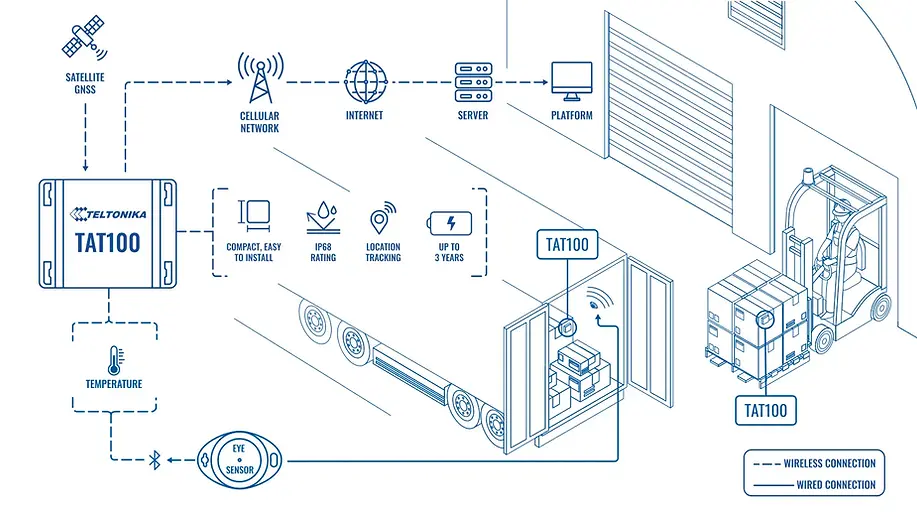
BLE tags pair to a fixed or vehicle-mounted gateway (cheaper at scale); cellular units (TAT140 on Cat-1, TAT141 on Cat-M1) report standalone.
Real-world scenarios
Typical setup — port / container yard
Container yard with reefers and dry boxes rotating between port, depot, and customer. The everyday pain: 'missing' containers that are actually misallocated. TAT140 on every container + gateway at the depot gives a live yard map showing what's where — the standard fix for yard-allocation chaos.
Typical setup — plant / generator rental
Rental fleet of portable generators or compactors. Frequent dispute pattern: customer claims a unit was swapped or returned but no proof. TAT140 with built-in Cat-1 + alarms gives you defensible position data through the rental window and surfaces unauthorised relocations early.
What you get out of it
- No install — magnetic mount or stick-on, deploy in 60s per asset
- Multi-year battery — fit and forget
- Scale to 100+ assets without per-tag cellular cost
- Survives outdoor / dusty / wet environments (IP67)
- Pairs with vehicle trackers for end-to-end visibility
FAQ
BLE (TAT140) is cheapest per asset, requires a gateway nearby (truck, depot, or office). Cellular (TAT140 on Cat-1, TAT141 on Cat-M1 + NB-IoT, TAT240 on 2G legacy) is standalone — more expensive per device but works anywhere with cell coverage. Most fleets use BLE for depot-resident assets and cellular for assets that travel alone.
Ready to spec it out?
We'll come back with pricing and a device recommendation tailored to your operation. Fast first reply during business hours, 08:00–17:00 SAST.
Other use cases