Driver behaviour & safety
Knowing where your vehicles are is the easy part. Knowing *how* they're being driven — harsh braking, speeding, idling, eco-driving score, fatigue indicators — is what changes insurance premiums and saves fuel. Teltonika's accelerometer + camera-ready models give you the data; the scoring lives in your platform.
Why driver scoring is where the money is
A fleet that knows position only is paying for the cheapest 10% of telematics. A fleet that scores drivers on harsh events, eco-driving, and fatigue typically sees 10-20% fuel savings, lower insurance premiums, and fewer accident-related downtime days. The numbers are stark and the case studies are everywhere.
The hardware part is solved — every Teltonika device has a built-in 3-axis accelerometer. The differentiation between the FMC900 series and the FMC650 / FMC800 is what extra sensors and inputs they support: driver-ID iButton, camera input for dashcam, fatigue (DSM) cameras, panic button.
We'll spec the right model for your scoring scheme — basic behaviour, camera-augmented, or full driver monitoring with DSM.
Capabilities to look for
3-axis accelerometer (all models)
Harsh acceleration, braking, cornering — every Teltonika device reports these natively.
Driver-ID iButton
Identify which driver is in which vehicle — scoring follows the driver, not the truck.
Camera input (FMC150, FMC650, FMC800)
Dashcam-ready models — integrate with FleetCam or similar video telematics platforms.
Accident / impact detection
Sharp deceleration triggers alarm + crash position — fast emergency response.
Eco-driving algorithm support
Most platforms (Wialon, Traccar) have eco-driving scoring built around Teltonika's data format.
Devices for driver behaviour & safety
Each device links to its full spec page. Add to your list and we'll come back with pricing.
The premium flagship for driver monitoring — accelerometer + camera input + advanced I/O. The choice for serious driver scoring programmes.
Cat-M1 + NB-IoT sibling of the FMC650 — pick this when the fleet runs cross-border SADC or coverage-marginal routes and you still need camera-based behaviour data.
Driver behaviour focus — high-frequency accelerometer + CAN + driver-ID iButton wiring. Best price-performance for behavioural scoring.
Cat-M1 + NB-IoT equivalent of the FMC880 — same behavioural focus, on a roaming-friendly modem for cross-border coaching programmes.
Entry-level for behaviour basics — every FMC920 reports harsh events out of the box.
How the data flows
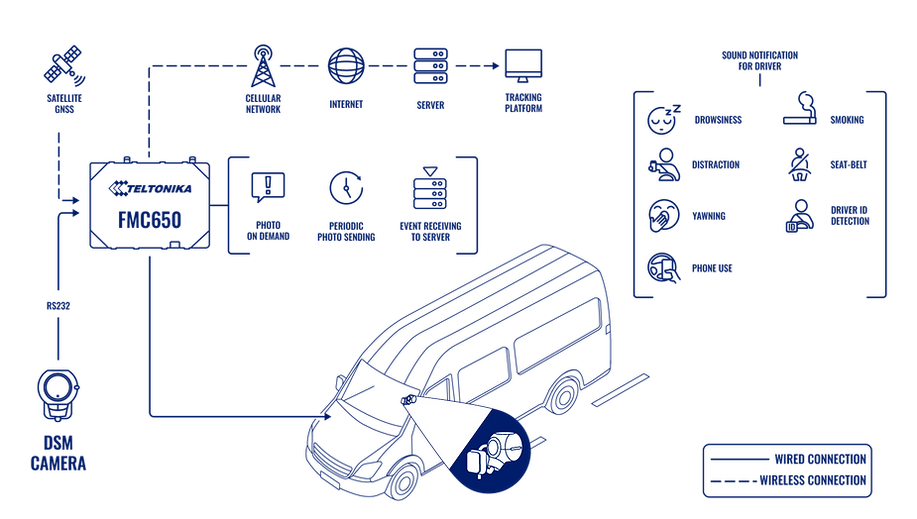
Driver iButton ties trips to a specific driver; behaviour events score per-driver, not per-vehicle. Monthly dashboards roll up to coaching.
Real-world scenarios
Typical setup — logistics fleet, insurance-driven scoring
Premium pressure after claim history forces a behaviour-monitoring mandate at renewal. FMC880 on each truck + driver-ID iButton + Wialon eco-driving scoring + monthly driver dashboard. The pattern that meets most underwriter mandates and gives HR a defensible scoring data trail.
Typical setup — intercity coach / long-haul fatigue
Coach or long-haul truck operator concerned about fatigue near-misses. FMC650 with DSM (driver state monitoring) camera + tachograph-style hour logging triggers reviews on excessive hours and microsleep events. The pattern for fatigue-risk fleets where the driver — not the engine — is the failure point.
What you get out of it
- Typical fuel savings from eco-driving programmes (industry figures vary by baseline)
- Many SA fleet insurers offer premium reductions for documented driver-behaviour programmes — ask your broker
- Fewer accident-related downtime days
- Defensible driver scoring data for HR / disciplinary action
- Accident-detection improves emergency response times
FAQ
Wialon and Traccar have built-in eco-driving and behaviour scoring — turnkey if you're starting fresh. For more sophisticated needs (DSM, video-augmented scoring) we pair with FleetCam, Geotab, or similar.
Ready to spec it out?
We'll come back with pricing and a device recommendation tailored to your operation. Fast first reply during business hours, 08:00–17:00 SAST.
Other use cases